
Enterprise local execution roadmap
Develop with Fabric Desktop by KratosBI. Execute on your infrastructure. Store and consume in Microsoft Fabric.
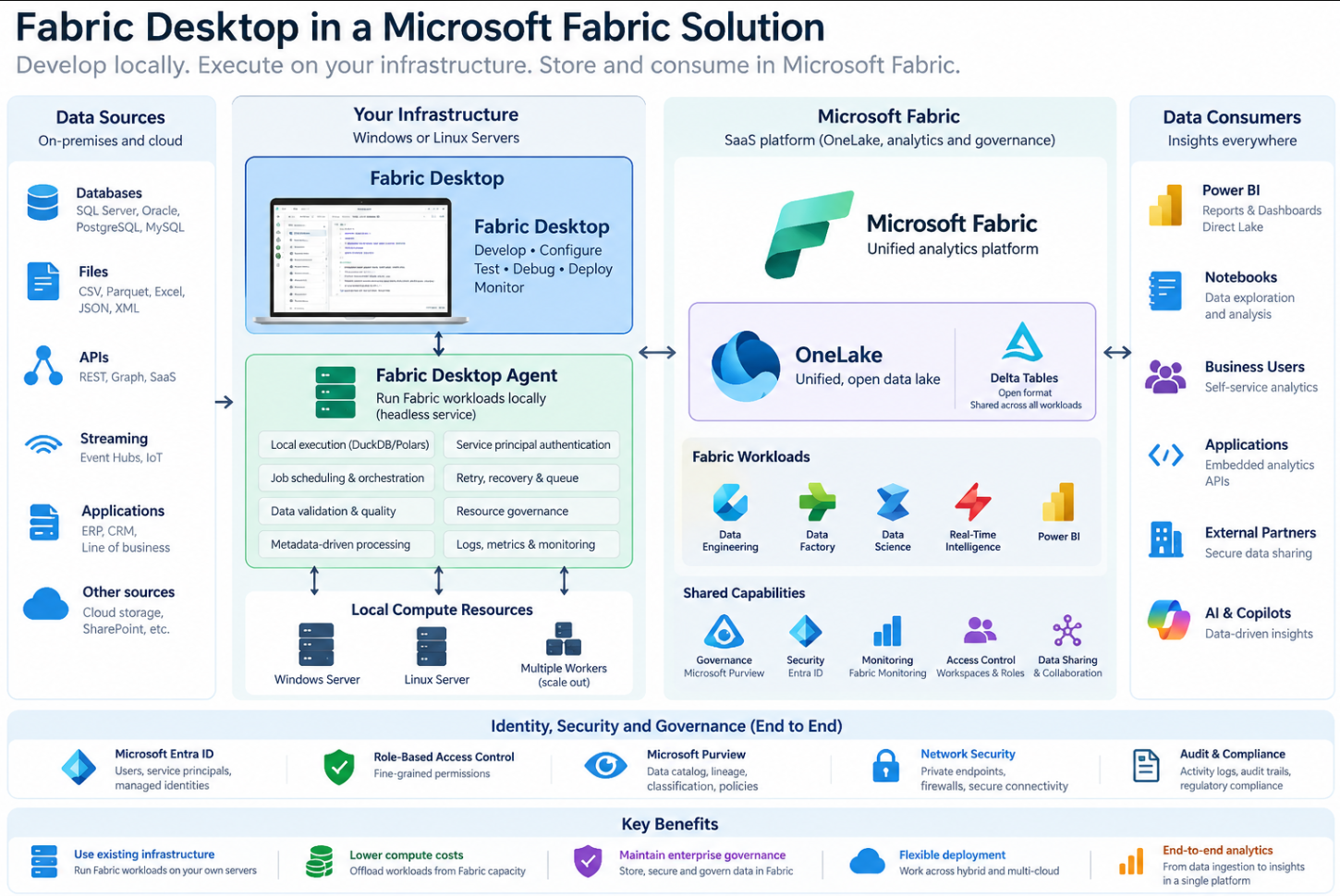
This is the assessment and plan for growing Fabric Desktop by KratosBI from a desktop development app into a platform that runs Fabric-compatible data engineering on your own Windows and Linux servers. It was written on 2026-10-15 against main at 8edf88a. Milestone M1, the headless agent, is now built.
Nothing in this document has been verified against a live Fabric tenant. Every Fabric API behaviour it relies on is marked as needing that check (milestone M0).
Summary#
The engine was reusable as it was; what runs it was not ready for unattended use. The metadata framework (meta/engine.py), the OneLake store and the Fabric runner already ran with no UI, and fabric-desktop run-schedule already ran unattended. What blocked an enterprise agent was everything around the engine: it signed in as one person, kept state in that person's %LOCALAPPDATA%, scheduled only through Windows Task Scheduler, and locked with files on one PC.
Two earlier decisions are reversed, as agreed on 2026-10-15:
- Windows only becomes Windows and Linux. The engine and the agent run on Linux; the desktop shell stays Windows.
- Sign in as the user, no service principal becomes service principal or managed identity for the agent. The desktop app keeps delegated sign-in.
The biggest correctness risk for more than one writer: every entity write reads the whole table, merges in memory and overwrites it (meta/engine.py, _write). That is safe with one writer and unsafe with two, so per-table write leases came first (now in M1).
Feature inventory (before M1)#
Paths are under sidecar/fabric_desktop/ unless they start with app/ or .github/. "Tested" means a unit test in sidecar/tests/ covers it; none was tested on a live tenant.
| Area | What exists | Where | Tested |
|---|---|---|---|
| Process model | Tauri shell spawns one Python sidecar, JSON lines over stdin/stdout; one Service object; method allowlist METHODS |
app/src-tauri/src/main.rs, server.py, service.py |
yes |
| CLI | serve, sign-in, preview, run, history, run-schedule <id> |
cli.py |
yes |
| Unattended mode | Service(headless=True): never opens a sign-in window, logs to a file, exits 1 on failure |
cli.py, service.py |
yes |
| Auth | MSAL public client, delegated, per-user token cache; no certificate, managed identity or workload identity | auth.py |
partly |
| Job files | TOML jobs, DuckDB SQL or Polars script, overwrite or append to a OneLake Delta table | jobs.py, publish.py |
yes |
| Delta writes | delta-rs to abfss:// by GUID; local staging copy; Fabric-safe profile check |
publish.py, delta_profile.py, onelake.py |
yes |
| OneLake files | ADLS Gen2 DFS list, download, upload, delete | onelake.py |
yes |
| Metadata engine | Entities in TOML, configurable layers, contracts, cleaning, checks, quarantine, SCD1/SCD2, incremental, hooks, replay, backfill, dependency order | meta/engine.py, meta/project.py |
yes |
| Entity write | Reads the whole table, merges in Polars, overwrites it in one commit stamped with run id and metadata version | meta/engine.py, meta/store.py |
yes |
| Run history | Delta tables in LH_Meta per environment: run_log, dq_results, watermarks, schema_history, deployments, restores |
meta/store.py |
yes |
| Surrogate keys | Central LH_Keys; Delta MERGE on business key, retried on CommitFailedError, duplicate-key detection |
meta/keys.py |
yes |
| Environments and promote | Dev/Test/Prod each with workspace, "Tables in" and "Runs on"; promote gates | meta_service.py, meta/promote.py, meta/testing.py |
yes |
| Fabric compute | Bundle upload to LH_Meta, runner notebook, RunNotebook, result file | fabric_compute.py, fabric_api.py |
unit only |
| Fabric REST client | 429 retry with Retry-After, long-running operations, paging; workspaces, lakehouses, notebooks, jobs, schedules, maintenance, models, roles, shortcuts, connections, variable libraries |
fabric_api.py |
unit only |
| Local schedules | Windows Task Scheduler; on other systems saved but never started; per-schedule lock file | local_schedules.py, schedule_service.py |
yes |
| Fabric schedules | List, create, enable, delete Fabric job schedules | schedule_service.py |
unit only |
| Alerts | Teams Workflows webhook for freshness misses and failed PC schedules | dataops_service.py, meta/freshness.py |
yes |
| Compatibility check | Regex scan of notebook cells | fabric_run.py (compute_check) |
yes |
| Spark on this PC | Spark SQL to DuckDB with sqlglot; DuckDB PySpark API; local notebookutils |
sql.py, spark_local.py, notebookutils_local.py |
yes |
| Cost | CU-seconds per run from run times, savings from local runs | costs.py |
yes |
| Table maintenance | Delta log health, Fabric TableMaintenance, local compaction, retention | maintenance.py, meta/restore.py |
yes |
| Secrets | Source config holds only Key Vault URL and secret name; validator rejects secret-looking fields | meta/keys.py, meta/varlib.py |
yes |
| CI/CD | Windows-only CI: tests, engine build, Trusted Signing (waiting on the account), release to latest; app self-updates |
.github/workflows/ci.yml, app/src-tauri/src/updater.py |
n/a |
Gap analysis#
| # | Priority | State before M1 | What existed | What was missing | After M1 |
|---|---|---|---|---|---|
| 1 | Headless agent | Partial | run-schedule and Service(headless=True) |
A long-running process; UI-free runtime; per-machine state | Built |
| 2 | Service principal and managed identity | Missing | Delegated MSAL only, but every consumer takes a token callable | Certificate, managed identity, workload identity; tenant setting; workspace roles | Certificate, secret and managed identity built; workload identity not yet |
| 3 | Durable scheduling, queues, retries, recovery | Partial | Task Scheduler; lock files; run logs | Crash-safe queue; retry policy; recovery; Linux scheduling | Built |
| 4 | Safe concurrent Delta writes | Partial | Atomic commits; LH_Keys MERGE retry | Leases for read-merge-overwrite; commit retry; meta-table compaction | Leases, version-checked commits on every write path and commit retry built; compaction not yet |
| 5 | Centralized logging and history | Partial | run_log and friends in LH_Meta |
Structured logs; worker and host on runs; export; heartbeat | JSON logs and run fields built; export is M4 |
| 6 | Fabric pipeline integration | Missing | Can trigger existing pipelines | Inbound trigger and status contract | M4 |
| 7 | Multiple workers, Windows and Linux | Missing | Engine runs on Linux | Worker registry, job claims, Linux CI, packaging | Linux CI and packaging built; multi-worker is M3 |
| 8 | Workload compatibility analyzer | Partial | Regex compute_check; sqlglot; PySpark shim |
AST and SQL analysis with verdicts and reasons | M5 |
| 9 | Governance, secrets, deployment controls | Partial | Promote gates; secret-name rule | Agent Key Vault; resource limits; allowlists; audit; pinned releases | Environment and workspace allowlists, secret refusal, pinned (non-self-updating) agent built; rest M2 and M6 |
| 10 | Cost and performance comparison | Partial | costs.py estimates |
Measured local cost; side-by-side timing | M5 |
Architecture changes#
Add an agent beside the desktop app; don't rebuild the engine. The desktop app, its RPC methods and its delegated sign-in keep working.
- A UI-free runtime.
runtime.pybuildsRuntimefrom the same mixins asService(projects, stores, maintenance, alerts), without the notebook kernel. The project and identity come fromagent.toml. - Credential providers.
credentials.py:ServicePrincipal(certificate or secret) andManagedIdentity, answering the same calls as the desktopAuthenticator, so stores and clients work unchanged. - Agent config and home.
agent_config.pyreadsagent.toml; the home folder is per machine (%ProgramData%or/var/lib), not per user. Secrets are refused. - Durable queue.
jobqueue.py: SQLite in WAL mode, job leases, exponential backoff, recovery of jobs whose worker died. - Per-table leases.
leases.py: conditional lease files inLH_Meta/Files/_fabric_desktop/leases/, renewed while writing; the engine holds one per entity run (Engine(table_lock=...)) and retries a lost commit race. - Scheduling inside the agent.
agent.pyevaluates[[schedule]]entries with the samenext_runlogic as PC schedules. - Structured logs and run fields.
logs.pyJSON lines;run_loggainsworker,host,attempt,job_id. - Fabric pipelines through a OneLake mailbox (M4): a pipeline writes a request file to LH_Meta; the agent runs it and writes the result, as the Fabric runner already does. No inbound port.
- Packaging per OS. systemd unit and container for Linux, a startup task for Windows; agent releases are installed deliberately, never self-updated.
Roadmap#
| Milestone | Priorities | Depends on | Exit gate | Status |
|---|---|---|---|---|
| M0 Live verification | 2, 4 | Entra app with certificate; tenant setting | A service principal writes to OneLake; two concurrent writers to one table end cleanly | Needs Chris's tenant |
| M1 Headless agent, one node | 1, 2, 3, 4, 5 | M0 for live use | Runs a metadata environment on a schedule on Windows and Linux for 7 days unattended; a killed job retries; no lost rows with two concurrent jobs | Built; live soak pending |
| M2 Enterprise security | 2, 9 | M1 | Managed identity on an Azure VM; Key Vault by principal; audit row per job; signed agent release | Next |
| M3 Multiple workers | 7, 3, 4 | M1, M2 | Two workers on different OSes share one environment; a job runs exactly once | Planned |
| M4 Pipelines and observability | 6, 5 | M1 | A Fabric pipeline starts a local run and waits; logs reach Azure Monitor or OpenTelemetry | Planned |
| M5 Compatibility and cost | 8, 10 | M1 | Per-workload verdict with reasons; measured local cost vs Fabric CU | Planned |
| M6 Governance controls | 9 | M2, M3 | Per-job memory and concurrency limits; approvals for Test and Prod | Planned |
If time is short: M0, M1, M2, then M4 before M3, since most teams need pipeline hand-off before a second worker.
Work items#
Draft issues. FD-n ids let dependencies point at each other.
| Id | Milestone | Title | Depends on | Status |
|---|---|---|---|---|
| FD-1 | M0 | Verify service principal access to Fabric and OneLake | Entra app, tenant setting | Open |
| FD-2 | M0 | Verify concurrent Delta commits and conditional requests on OneLake | FD-1 | Open |
| FD-3 | M1 | UI-free Runtime |
none | Done |
| FD-4 | M1 | Credential providers (certificate, secret, managed identity) | FD-3 | Done |
| FD-5 | M1 | Agent home and agent.toml |
FD-3 | Done |
| FD-6 | M1 | Durable job queue with retries and recovery | FD-5 | Done |
| FD-7 | M1 | Per-table write leases and commit retry | FD-2, FD-3 | Done (live check in FD-2) |
| FD-8 | M1 | fabric-desktop agent command |
FD-4 to FD-7 | Done |
| FD-9 | M1 | JSON logs and run-row fields | FD-8 | Done |
| FD-10 | M1 | Linux CI and agent packaging | FD-8 | Done |
| FD-11 | M2 | Key Vault, audit and workload identity for the agent | FD-4 | Open |
| FD-12 | M3 | Shared job claims across workers | FD-6, FD-7, FD-11 | Open |
| FD-13 | M4 | Pipeline mailbox | FD-8 | Open |
| FD-14 | M5 | Workload compatibility analyzer | FD-3 | Open |
| FD-15 | M5 | Measured local cost and side-by-side comparison | FD-9 | Open |
Acceptance criteria#
FD-1 Verify service principal access. A script signs in with a certificate, lists workspaces, creates a lakehouse and writes a Delta table by GUID path. The result, with each role or setting that was needed, is recorded in docs/live-verification.md.
FD-2 Verify concurrent commits and conditional requests. Two processes write one OneLake table at once, 20 times; report conflicts raised, any lost commit, and the exception type. Confirm OneLake honours If-None-Match: * and If-Match on DFS create, flush and delete (the lease files depend on it).
FD-3 UI-free Runtime. Holds project, stores, credentials, run and alerts with no kernel or UI state; every RPC method still resolves and existing tests pass unchanged.
FD-4 Credential providers. Certificate, secret and managed identity; chosen by agent.toml; desktop unchanged; a clear error when sign-in fails.
FD-5 Agent home and config. FABRIC_DESKTOP_HOME and per-OS defaults; config validated at start with one line per problem; secrets refused.
FD-6 Durable queue. States queued, running, succeeded, failed, dead; backoff with a cap; a killed worker's job runs again once after restart.
FD-7 Leases and commit retry. Lease per table in LH_Meta, renewed while writing, released after, taken over once expired; entity write retries a lost commit race by re-reading and re-merging; two concurrent runs of one table keep every row.
FD-8 Agent command. Long-running loop with schedules, concurrency, clean shutdown on SIGTERM; check, status and enqueue commands; runs the existing Engine.
FD-9 Logs and run fields. JSON lines with job id, run id, worker, host; run_log gains worker, host, attempt, job_id; older rows still read.
FD-10 Linux CI and packaging. CI runs the tests on Ubuntu too; container image and systemd unit; Windows startup task; the agent never self-updates.
FD-11 Key Vault, audit, workload identity. Source secrets read by the agent's principal and never logged; every enqueue records who or what queued it; workload identity federation for Kubernetes and GitHub-hosted runners.
FD-12 Shared job claims. Workers register and heartbeat in LH_Meta; one worker claims a job via a conditional-create claim file; a stopped worker's claim expires and another runs the job; no job runs twice.
FD-13 Pipeline mailbox. Contract for requests/<id>.json and results/<id>.json plus a sample Fabric pipeline that writes a request and waits; duplicates ignored; malformed requests answered with the reason.
FD-14 Compatibility analyzer. Parses notebook Python (AST) and SQL (sqlglot), lists each unsupported Spark API or SQL feature with cell and line, and gives run here, run in Fabric or rewrite per workload; replaces compute_check keeping its output shape.
FD-15 Measured cost. Each local run records CPU-seconds and peak memory; a machine cost per hour turns that into money; the cost view compares local and Fabric runs of the same entity and labels estimates.
Need a hand?
Find a fix in troubleshooting, or share a reproducible issue with the community.
Get support ↗Improve this guide on GitHub ↗